Address
304 North Cardinal St.
Dorchester Center, MA 02124
Work Hours
Monday to Friday: 7AM - 7PM
Weekend: 10AM - 5PM
Address
304 North Cardinal St.
Dorchester Center, MA 02124
Work Hours
Monday to Friday: 7AM - 7PM
Weekend: 10AM - 5PM


3003 aluminum tread plate is one of the most ordered non-slip aluminum products in the world. It combines the workability of 3003 alloy with a raised surface pattern that adds grip without adding much weight.

3003 Aluminum Tread Plate
3003 is a manganese-aluminum alloy. It contains 1.0–1.5% manganese, which raises strength above pure aluminum without making the material brittle or hard to form. It is non-heat-treatable, which means strength comes from the alloy composition and work hardening, not heat treatment.
Compared to 1100 (the other common tread plate alloy), 3003 offers:
| Property | 1100 Alloy | 3003 Alloy |
|---|---|---|
| Tensile Strength | ~124 MPa | ~150–165 MPa |
| Yield Strength | ~103 MPa | ~125–145 MPa |
| Corrosion Resistance | Good | Very Good |
| Formability | Excellent | Very Good |
| Weldability | Excellent | Excellent |
| Cost | Slightly Lower | Slightly Higher |
3003 is the better choice when the plate needs to handle more load or resist corrosion in outdoor and moist environments.
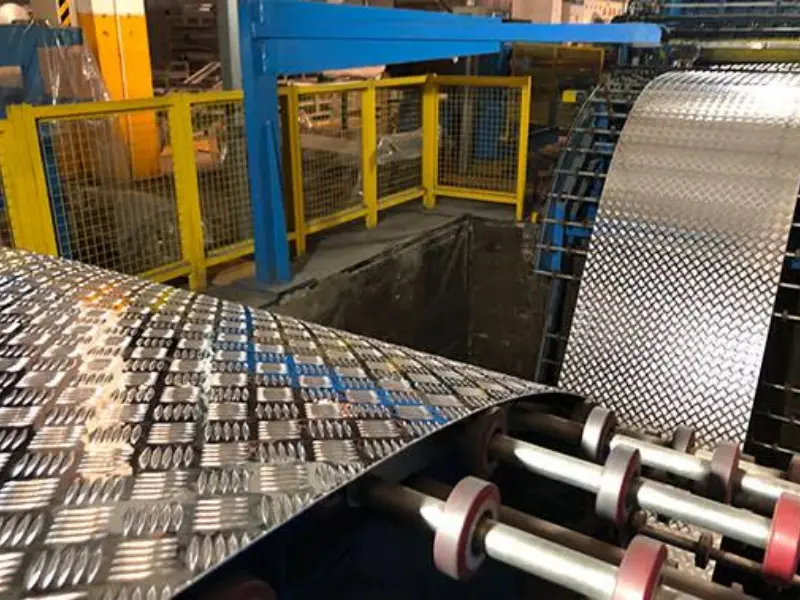
The raised pattern is pressed into the plate surface during rolling using an embossing roll. The pattern creates friction underfoot or under wheels, reducing slip risk. The raised elements also add stiffness to the plate — a 3mm tread plate resists flex better than a 3mm plain plate of the same alloy.
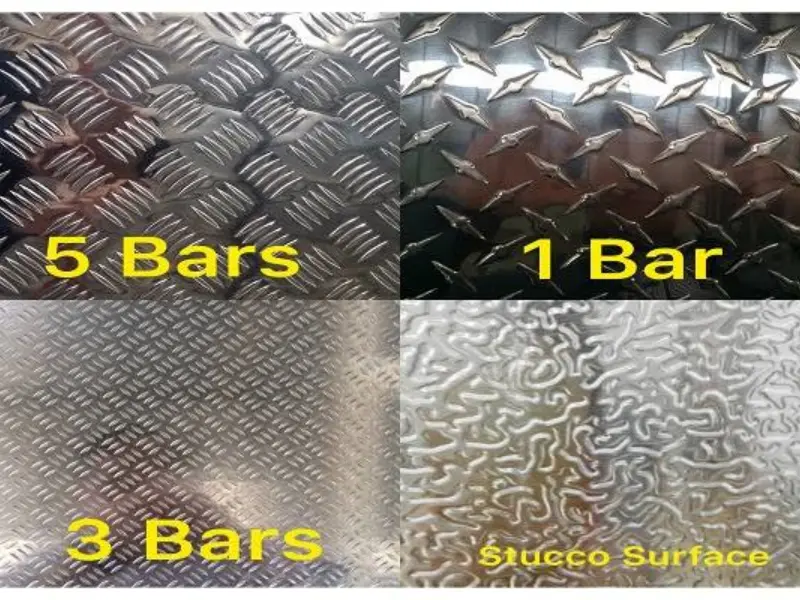
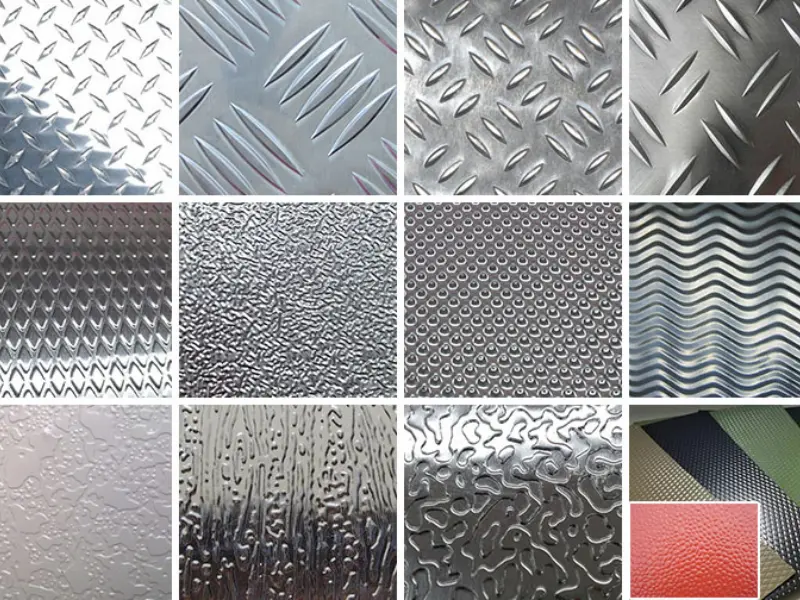
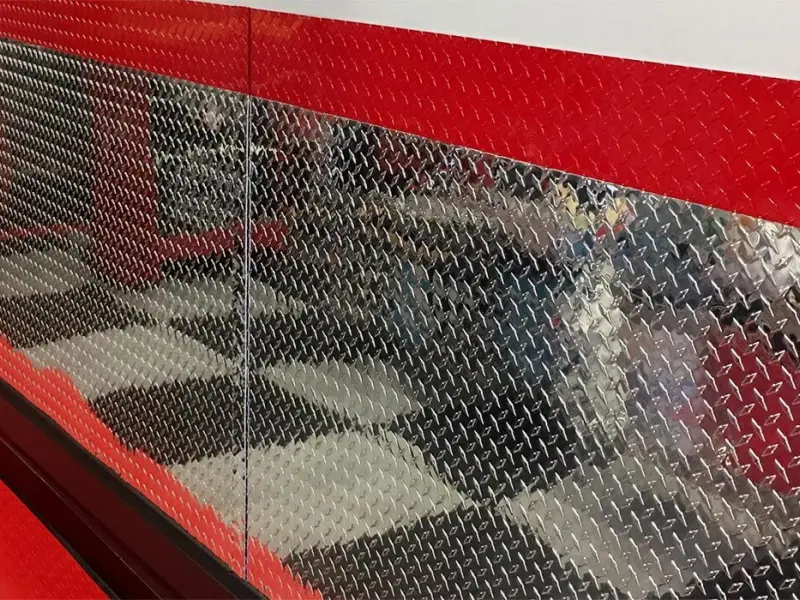
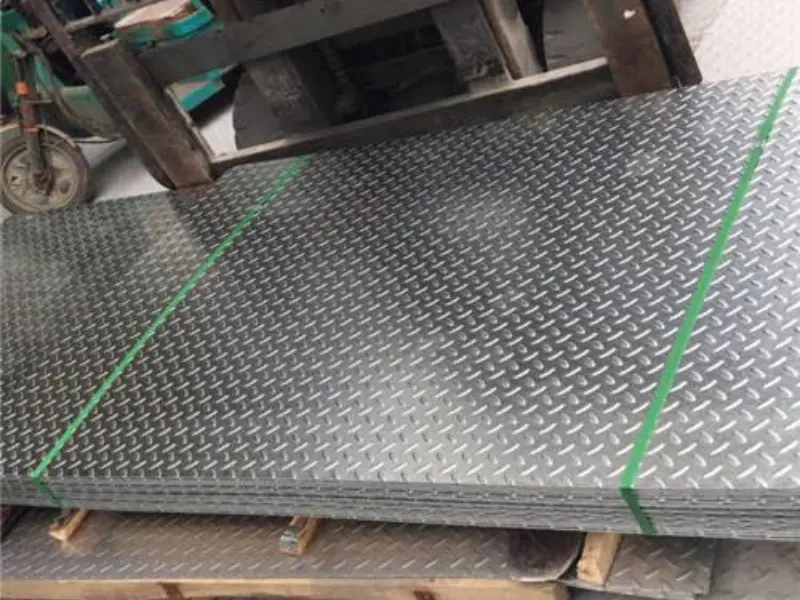
One raised diamond shape repeated across the surface. This is the most common tread plate pattern globally. The diamonds sit at roughly 45° to the rolling direction. Clean lines, easy to clean, and attractive enough for visible architectural use.
Used for: floor plates, ramps, step treads, truck decks, decorative panels
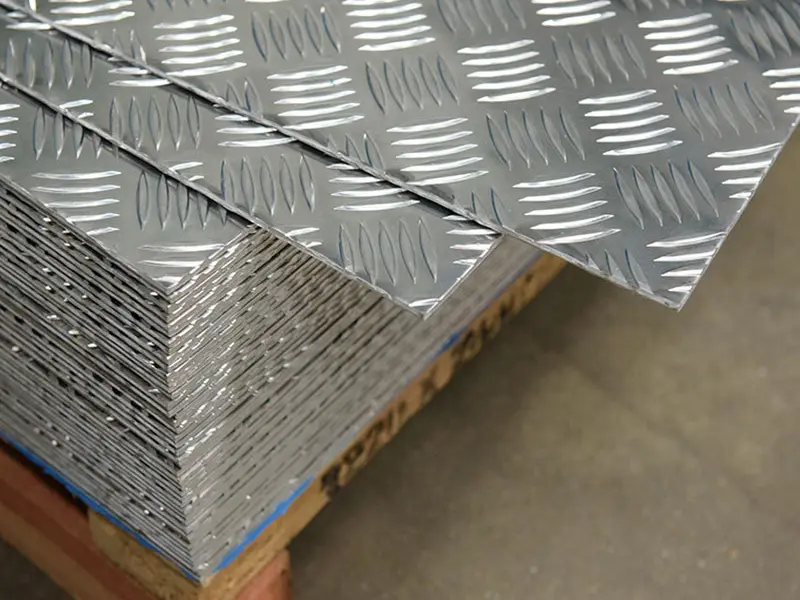
Five parallel raised bars in a repeating unit. The bars run at an angle to the plate edge. This pattern is extremely common in North America and Europe for industrial flooring. It provides more contact area per unit than diamond and is very recognizable in industrial settings.
Used for: industrial floor plates, vehicle running boards, trailer floors, workshop floors
Three bars per repeating unit, similar to five-bar but slightly lighter pattern density. Used where five-bar feels visually heavy or where a lighter pattern serves the design requirement.
Used for: decorative flooring, light-duty ramps, interior steps
Two raised bars per unit, often at opposing angles giving a herringbone effect. Less common than five-bar but used in specific architectural and automotive applications.
Used for: custom vehicle interiors, decorative applications
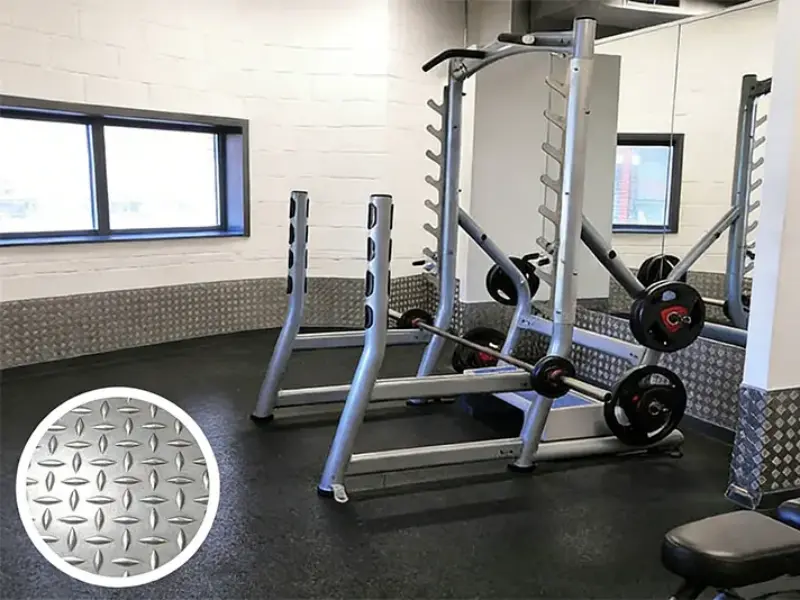
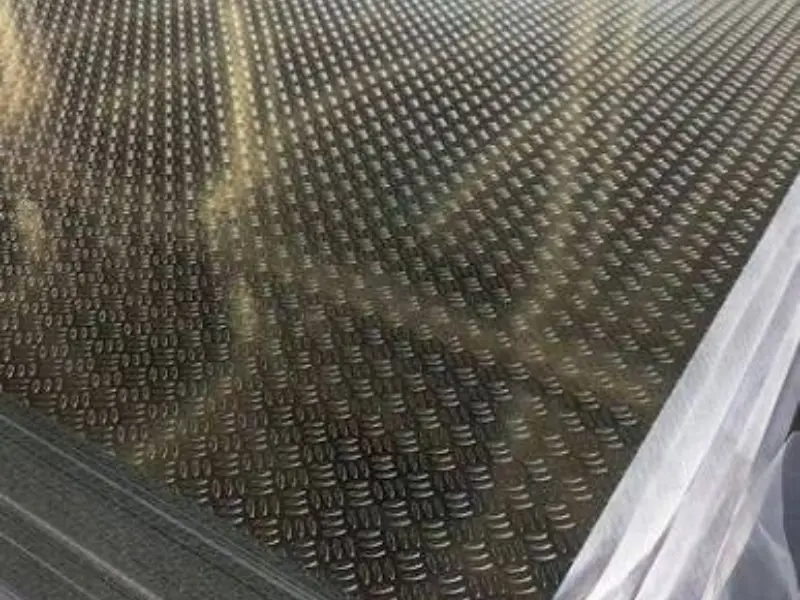
Raised oval or lens-shaped elements in a regular grid. Gives a softer, more rounded visual appearance. Often seen in elevator flooring, retail display platforms, and upscale interior commercial flooring.
Used for: elevators, retail spaces, high-end interior flooring
| Pattern | Visual Style | Slip Resistance | Common Market | Best Application |
|---|---|---|---|---|
| Diamond (1-bar) | Clean, geometric | Good | Global | Ramps, steps, decorative |
| Five-bar | Industrial, bold | Very Good | North America, Europe | Industrial floors, trucks |
| Three-bar | Moderate | Good | Asia, Europe | General flooring |
| Two-bar (pointer) | Light, angular | Moderate | Automotive | Custom interiors |
| Lenticular | Rounded, refined | Good | Architectural | Elevators, retail |
Temper tells you how hard and strong the plate is. 3003 tread plate comes in several tempers, each suited to different uses.
| Temper | Condition | Tensile Strength | Yield Strength | Best For |
|---|---|---|---|---|
| O | Fully annealed, softest | ~130 MPa | ~55 MPa | Deep forming, tight bends |
| H14 | Half hard, strain hardened | ~165 MPa | ~145 MPa | General flooring, ramps |
| H22 | Quarter hard, strain hardened + partial anneal | ~155 MPa | ~115 MPa | Moderate forming + strength |
| H24 | Half hard, strain hardened + partial anneal | ~165 MPa | ~140 MPa | General use, good balance |
| H34 | Three-quarter hard | ~180 MPa | ~165 MPa | Higher strength flooring |
For most tread plate applications — flooring, ramps, step covers, truck decks — H14 or H24 is the standard spec. These tempers give a good balance of strength and enough ductility to allow field cutting and bending without cracking.
| Thickness | Weight per m² | Typical Use |
|---|---|---|
| 1.5 mm | ~4.6 kg | Light decorative panels, interior steps |
| 2.0 mm | ~6.2 kg | Light-duty flooring, ramps |
| 2.5 mm | ~7.7 kg | General indoor flooring |
| 3.0 mm | ~9.3 kg | Standard floor plate, step covers |
| 4.0 mm | ~12.4 kg | Heavy-duty ramps, truck beds |
| 5.0 mm | ~15.5 kg | Industrial flooring, loading docks |
| 6.0 mm | ~18.6 kg | Heavy load flooring, structural |
| 8.0 mm | ~24.8 kg | Extreme load applications |
The most ordered thickness for general commercial and industrial use is 3.0 mm to 5.0 mm. Below 2.0mm, the plate flexes too much underfoot for standalone flooring. Above 6.0mm, weight becomes a factor in mobile or elevated applications.
| Size (Imperial) | Size (Metric) | Market |
|---|---|---|
| 4 × 8 ft | 1220 × 2440 mm | North America, global |
| 4 × 10 ft | 1220 × 3050 mm | North America |
| 5 × 10 ft | 1524 × 3050 mm | Industrial, marine |
| 4 × 12 ft | 1220 × 3660 mm | Long runs, truck bodies |
| 1000 × 2000 mm | — | Asia, Europe |
| 1250 × 2500 mm | — | Europe |
| 1500 × 3000 mm | — | Heavy fabrication |
| Custom | Any | OEM cut to order |
The raised pattern height affects grip and appearance. Most tread plate has a standard bump height of 0.8 mm to 1.5 mm above the base plate surface. This is enough for good slip resistance without making the surface hard to clean or uncomfortable underfoot.
Weight (kg) = Length (m) × Width (m) × Thickness (m) × 2,710 kg/m³
Note: the raised pattern adds approximately 5–8% to the calculated weight of plain plate at the same nominal thickness. Most suppliers quote weight including the pattern.
| Thickness | Sheet Weight (approx.) | Notes |
|---|---|---|
| 2.0 mm | ~24.0 kg (53 lb) | Light duty |
| 3.0 mm | ~35.8 kg (79 lb) | Standard |
| 4.0 mm | ~47.8 kg (105 lb) | Heavy duty |
| 5.0 mm | ~59.7 kg (132 lb) | Industrial |
| 6.0 mm | ~71.6 kg (158 lb) | Structural |




1100 is nearly pure aluminum (99%+ Al). It is softer and slightly cheaper than 3003. For decorative indoor applications where corrosion is not an issue and loads are light, 1100 works fine. For anything outdoors, structural, or exposed to moisture — 3003 is the better call.
| Feature | 1100 Tread Plate | 3003 Tread Plate |
|---|---|---|
| Strength | Lower | Higher |
| Corrosion resistance | Good | Very Good |
| Outdoor suitability | Limited | Yes |
| Formability | Better | Good |
| Cost | Slightly lower | Standard |
| Weldability | Excellent | Excellent |
5052 is a magnesium-aluminum alloy with significantly higher strength and excellent corrosion resistance. It suits marine environments and chemical exposure. However, 5052 is harder to form and costs more. For coastal marine decking or chemical plant floors, 5052 is the right pick. For general construction and transportation, 3003 gives enough performance at lower cost.
| Feature | 3003 Tread Plate | 5052 Tread Plate |
|---|---|---|
| Tensile Strength | 150–165 MPa | 210–260 MPa |
| Corrosion Resistance | Very Good | Excellent |
| Marine Use | Moderate | Yes |
| Formability | Good | Moderate |
| Cost | Lower | Higher (+15–25%) |
| Common Use | General industrial | Marine, chemical |
6061-T6 is a heat-treated structural alloy. It is much stronger than 3003 but significantly harder to form and weld. 6061 tread plate is used where structural load demands exceed what 3003 can handle — elevated platforms carrying heavy machinery, for example. Cost is 25–40% higher than 3003.
| Feature | 3003 Tread Plate | 6061 Tread Plate |
|---|---|---|
| Tensile Strength | 150–165 MPa | 290–310 MPa |
| Yield Strength | 125–145 MPa | 270–280 MPa |
| Formability | Good | Moderate |
| Weldability | Excellent | Good (needs care) |
| Cost | Base | +25–40% |
| Best For | General use | Heavy structural |
Steel diamond plate is heavier, stronger, and cheaper per ton — but it rusts without coating and costs more in maintenance over time. For food processing, marine, pharmaceutical, and outdoor applications, aluminum wins on corrosion resistance and service life. For heavy industrial floor plates carrying fork lifts and machinery, carbon steel is still common because of its higher load capacity and lower material cost.
| Feature | 3003 Aluminum Tread | Carbon Steel Tread |
|---|---|---|
| Weight (3mm plate per m²) | ~9.3 kg | ~23.5 kg |
| Corrosion resistance | Excellent | Poor (rusts) |
| Maintenance cost | Low | Higher |
| Tensile strength | 150–165 MPa | 400–550 MPa |
| Cost per ton | Higher | Lower |
| Best environment | Wet, food, marine | Dry, heavy load |
Standard tread plate comes with a mill finish — no additional surface treatment. The surface has the natural appearance of rolled aluminum with an embossed pattern. This suits most industrial and structural applications.
The base plate is polished before or after embossing for a reflective appearance. Used in decorative applications — retail floors, display platforms, elevator cabs. Costs 10–20% more than mill finish.
An anodize layer (10–25 microns) is applied after embossing. This adds hardness and a more uniform decorative appearance. Clear anodize keeps the silver look. Black anodize is popular in architectural and automotive trim applications. Adds USD 300–500 per ton above mill finish price.
A PE or PVDF coating is applied to the flat (back) side of the tread plate for some applications. The pattern side usually stays uncoated. Used in roofing and cladding applications where the tread pattern provides texture rather than flooring slip resistance.
| Thickness | Pattern | Price Per Ton (USD) | Price Per Sheet (4×8 ft) |
|---|---|---|---|
| 2.0 mm | Diamond or five-bar | 2,600–3,000 | USD 62–72 |
| 3.0 mm | Diamond or five-bar | 2,600–3,000 | USD 93–108 |
| 4.0 mm | Diamond or five-bar | 2,650–3,050 | USD 127–146 |
| 5.0 mm | Diamond or five-bar | 2,700–3,100 | USD 161–185 |
| 6.0 mm | Diamond or five-bar | 2,750–3,200 | USD 198–230 |
Prices are factory direct estimates at 5-ton+ orders. Local distributor prices are typically 20–35% higher. Anodized or polished finish adds USD 300–600 per ton.
→ Alloy and temper: H14 and H24 cost slightly more than O temper due to controlled rolling → Pattern type: five-bar and diamond are standard; lenticular or custom patterns add 5–10% → Thickness: heavier plate costs more per sheet but slightly less per ton (lower conversion premium) → Order size: orders above 10 tons unlock better per-ton pricing → Surface finish: mill finish is base; anodized and polished add significant premium → Custom cut: any size other than standard 4×8 or 4×10 ft adds cutting charge
3003 aluminum ingots are melted with manganese additions to reach the alloy composition. The melt is cast into rolling slabs by DC (direct chill) casting.
Slabs are heated to 400–500°C and hot-rolled down to approximately 6–8 mm thickness. At this stage, the plate is still plain with no surface pattern.
The hot-rolled plate passes through a cold rolling mill. On the final cold rolling pass, an embossing roll with the raised pattern engraved in negative presses the pattern into the plate surface. The pattern is formed by the cold rolling pressure — no separate stamping step is needed.
For O temper: the plate is annealed in a batch oven to fully soften. For H14/H24: the rolling strain is partially maintained to achieve the target strength level. H24 undergoes a partial stabilization anneal after rolling.
The plate passes through a roller leveler for flatness. Thickness, pattern height, surface quality, and mechanical properties are checked against spec.
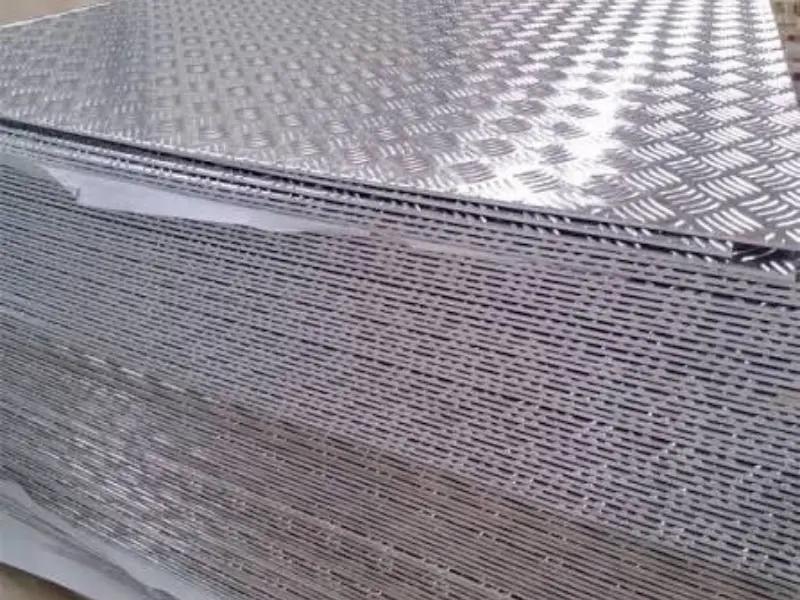
Plates are shear-cut to standard sizes. A PE protective film is applied to the pattern surface for some orders. Plates are stacked, palletized, and wrapped for shipment.
| Test | Standard | Target |
|---|---|---|
| Thickness | ASTM B209 | ± 0.15 mm |
| Alloy composition | ASTM B209 / EN 573 | Mn 1.0–1.5% |
| Tensile strength | ASTM E8 | Per temper spec |
| Pattern height | Internal spec | 0.8–1.5 mm |
| Flatness | ASTM B209 | ≤ 3 mm per 1000 mm |
| Surface defects | Visual | No cracks, tears, heavy oxide |
| Method | Cost | Transit Time | Best For |
|---|---|---|---|
| Sea (FCL) | Lowest | 18–40 days | 5+ ton orders |
| Sea (LCL) | Moderate | 25–45 days | 1–5 ton orders |
| Air freight | High | 5–10 days | Samples / urgent |
Alloy: 3003. Temper: H14 or H24. Pattern: diamond or five-bar. Thickness and size. Surface: mill finish or anodized.
Ask for one or two sheets before committing to a full order. Check pattern height, surface quality, and flatness before approving.
Get at least three quotes with the same spec. Compare delivered price (mill price + freight + duty), not just FOB mill price.
Request the mill test report confirming alloy composition and mechanical properties. This should be available before or at the time of shipment — not after.
For orders above 5 tons, third-party inspection (SGS or BV) at the mill before loading is worth the fee. It catches issues before the container ships.
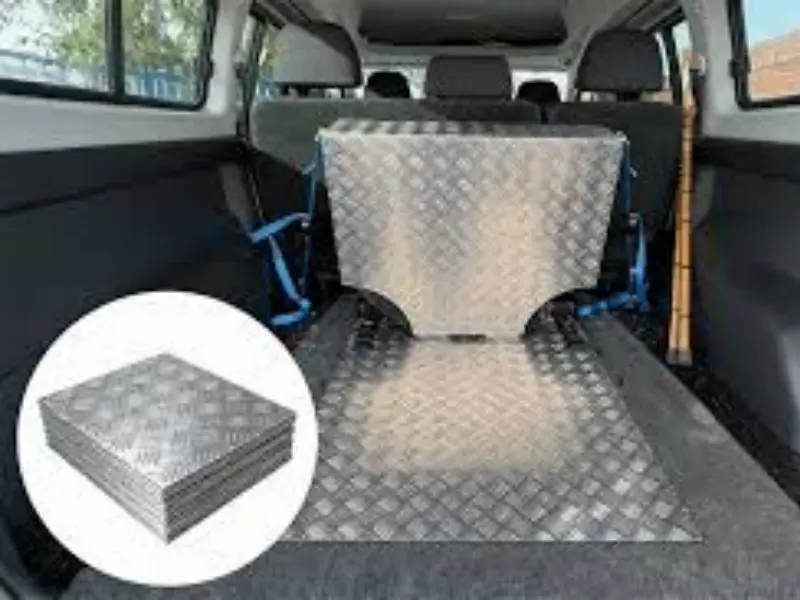
3003 tread plate is used wherever a non-slip aluminum surface is needed — truck beds, trailer floors, industrial walkways, ramps, step treads, boat decks, and commercial flooring. The raised pattern provides grip underfoot or under tires, and the 3003 alloy gives corrosion resistance for outdoor and wet environments.
Diamond plate (one-bar) has a repeating diamond raised pattern at 45° to the plate edge. Five-bar has five parallel raised bars per repeating unit. Both provide similar slip resistance. Diamond is more common in decorative and automotive applications. Five-bar is more common in heavy industrial flooring and North American trailer decking.
For light pickup truck beds with personal use loads, 2.0–3.0mm is adequate. By commercial truck beds carrying heavy cargo or equipment, 4.0–5.0mm is more appropriate. For trailer decking designed for fork lift access, 5.0–6.0mm is the standard range.
Yes. 3003 welds easily with TIG or MIG using 4043 or 5356 filler rod. 4043 is the most common choice. Weld quality is generally better than 5xxx series alloys in terms of crack resistance. The pattern area should be cleaned of oxide before welding.
Yes. 3003 has good natural corrosion resistance from its oxide layer, which self-repairs when scratched. It handles rain, UV, and temperature cycling well without painting. For coastal or marine environments with salt spray, 5052 tread plate is a better long-term choice.
Most standard tread plate has a raised pattern height of 0.8–1.5mm above the base plate surface. This is enough for effective slip resistance without making the surface uncomfortable underfoot or hard to clean. Custom pattern heights outside this range require a special order.
3003 aluminum tread plate is a practical, cost-effective choice for the vast majority of non-slip flooring and structural applications. H14 or H24 temper covers most needs. Diamond and five-bar patterns are both widely stocked and readily available from Chinese mills.
The key decision points are thickness (match to load requirement), pattern (match to aesthetic and functional need), and surface finish (mill finish for industrial, anodized or polished for visible architectural use).
Order a sample before placing a full container order. Confirm the mill test report. And compare total landed cost — not just the per-ton mill price — across your supplier options.